Asimov's SF, September 2005 by Unknown
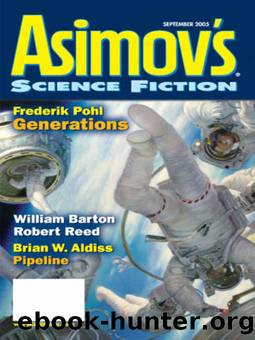
Author:Unknown
Language: eng
Format: mobi
Published: 2011-07-10T14:01:04+00:00
Copyright (c) 2005 by William Barton.
Authorâs Note:
As with most so-called Alternate History, everything in this story is âpossibly true,â in the sense that at least the kernel of the thing existed in our real timeline. How these things would have played out is a matter of conjecture, bordering on fantasy.
âHarvest Moonâ is based on a 1959 Army feasibility study called Project Horizon, initially known as Project Mountain Top, which called for the construction of a space station and permanent moonbase in the mid 1960s, using technology then under development. It proposed using a conceptual Saturn vehicle, consisting of a Saturn C-1 first stage, with a Titan ICBM booster as the second stage, and a Centaur third stage to land small cargo packages on the Moon, with men following in a two-man vehicle using the Earth-orbit rendezvous technique. It wouldâve required hundreds of launches, at an average rate exceeding sixty per year. And, oh yes, Horizon included a return capability from the start. There was also a real Project Adam, proposed by the Army Ballistic Missile Agency, and it sort of really flew, as the two Mercury-Redstone suborbital missions of 1961.
The real Project Gemini was remotely descended from the Air Forceâs Project MISS of the 1950s, MISS standing in Phase I for Man in Space Soonest, and in Phase II for Man in Space Sophisticated. In the story, Gemini A is our Gemini, which flew ten missions in 1965-1966. Gemini B is based on the Manned Orbiting Laboratory, whose hardware was actually built, but never flown. The real MOL was considerably heavier than what I describe here. Gemini C and M are the B variant stripped of reentry hardware and mounted on a hypothetical lunar descent stage. Gemini T is based on the âBig Geminiâ proposal put forward when it looked like Apollo might never fly. Gemini R is a hodge-podge of MOL and Apollo LM hardware.
I think everyone of a certain age will remember the Air Forceâs X-20 DynaSoar, a reusable spacecraft proposed to be launched atop a Titan II ICBM. There was an unmanned version called Asset that really flew, and these, along with various lifting-body testbeds, were ancestral to the Space Shuttle.
The Titan IIIZ of the story is based on the Titan IIIC, a Titan II ICBM with two strap-on segmented solid rocket motors, and a transtage whose engines were the same ones used in the Apollo Lunar Module. The IIIZ comes from a proposal to build a much bigger version, by scaling the Titan tankage from ten to fifteen feet diameter, and bolting on four solids. The US really did build nuclear rocket engines under the aegis of Project NERVA. The Rover 1 engine, with 75,000 lbs. thrust, was ready for flight testing in 1973, but the program was canceled.
In our timeline, Project Apollo succeeded partly because a certain German engineer politicked to have his brainchild become the American space program, but mostly because it was associated with a certain American president who was murdered in public.
The
Download
This site does not store any files on its server. We only index and link to content provided by other sites. Please contact the content providers to delete copyright contents if any and email us, we'll remove relevant links or contents immediately.
Personalized inhaled bacteriophage therapy for treatment of multidrug-resistant Pseudomonas aeruginosa in cystic fibrosis by unknow(175611)
CONSORT 2025 statement: updated guideline for reporting randomized trials by unknow(84042)
Critical evaluation of the ProfiLER-02 study design and outcomes by Vivek Subbiah & Razelle Kurzrock(83703)
Cardiac gene therapy makes a comeback by Oliver J. Müller & Susanne Hille & Anca Kliesow Remes(83506)
Whisky: Malt Whiskies of Scotland (Collins Little Books) by dominic roskrow(74438)
Unveiling the design rules for tunable emission in graphene quantum dots: A high-throughput TDDFT and machine learning perspective by Şener Özönder & Mustafa Coşkun Özdemir & Caner Ünlü(50893)
A yeast-based oral therapeutic delivers immune checkpoint inhibitors to reduce intestinal tumor burden by unknow(40260)
Covalent hitchhikers guide proteins to the nucleus by Alexander F. Russell & Madeline F. Currie & Champak Chatterjee(40216)
Meet the Authors: Christopher R. Mansfield and Emily R. Derbyshire by Christopher R. Mansfield & Emily R. Derbyshire(40096)
Alkaline-earth metals promote propane dehydrogenation with carbon dioxide through geometric effects: Altering the reaction pathway by unknow(32731)
Induced iron vacancies boosting FeOOH loaded on sustainable Fenton-like collagen fiber membrane for efficient removal of emerging contaminants by unknow(32507)
Efficient electric-field-assisted photochemical conversion of methane to n-propanol exclusively over penetrated TiO2Ti hollow fibers by Guanghui Feng(32453)
Bi2SiO5 nanosheets as piezo-photocatalyst for efficient degradation of 2,4-Dichlorophenol by Hangyu Shi & Yifu Li & Lishan Zhang & Guoguan Liu & Qian Zhang & Xuan Ru & Shan Zhong(32387)
A novel NDIPTA organic heterojunction photocatalyst with built-in electric field for efficient hydrogen production by Jiahui Yang & Baojun Ma & Yongfa Zhu(32361)
Enhanced conversion of methane to liquid-phase oxygenates via hollow ferrite nanotube@horseradish peroxidase based photoenzymatic catalysis by Jun Duan & Shiying Fan & Xinyong Li & Shaomin Liu(32333)
Ordered macroporous superstructure of defective carbon adorned with tiny cobalt sulfide for selective electrocatalytic hydrogenation of cinnamaldehyde by Xiao-Shi Yuan & Sheng-Hua Zhou & San-Mei Wang & Wenbo Wei & Xiaofang Li & Xin-Tao Wu & Qi-Long Zhu(32257)
What's Done in Darkness by Kayla Perrin(27148)
Topological analysis of non-conjugated ethylene oxide cored dendrimers decorated with tetraphenylethylene: Insights from degree-based descriptors using the polynomial approach by A Theertha Nair & D Antony Xavier & Annmaria Baby & S Akhila(26523)
Investigation of mechanical and self-healing properties of hydroxyl-terminated polybutadiene functionalized with 2-ureido-4-pyrimidinone by Mohsen Kazazi & Mehran Hayaty & Ali Mousaviazar(26458)
